Superb quality and spec AB-Com PULSe 4K SE. Crazy offer! Only £129! FREE UK DELIVERY! 4K UHD, Enigma 2, Multiboot 4 images & more!...
Superb quality and spec AB-Com PULSe 4K Rev II Twin Satellite tuner only £179! FREE UK DELIVERY! 4K UHD, Enigma 2, SATA HDD facility, Multiboot 4 images & more!...

[ABM-DVB-T/T2] ABM (UK-Terrestrail ): Add HD channels/regions REVISTED Bluebell Hill

Status
Not open for further replies.

adm

Forum Supporter
Donated Member
Joined
Sep 9, 2014
Messages
1,774
Reaction score
25
Points
48
Location
Southend on Sea, UK
I was seeing something very strange from the Bluebell Hill Terrestrial transmitter where nearly all the channels are devoid of a picture and sound and selecting them gives “Service not found – (SID not found in PAT)” The only channel that appeared to be working is a local Kent channel.

https://ukfree.tv/transmitters/tv/Bluebell_Hill
says transmitter frequencies change at the end of next month.

http://www.digitaluk.co.uk/coveragec...E5+9RD/NA/0/NA
Says they have already changed plus it gives some more information on transmitter channel numbers.

My investigation shows that the frequencies/MUX allocations have changed as per the second link PLUS a local mux on transmitter channel 21

I'm running ABM 3.1 and the latest terrestrail_uk_freeview.xml file is now out of date with regards the Bluebell Hill transmitter.

I have modified my copy (attached) and have got the Bluebell Hill transmitter working again in ABM. lamedb file also attached

View attachment terrestrial_uk_freeview_mod_for_bluebell_hill.zip

View attachment lamedb.zip
 

As an experiment I have tried it.

The results are not good

It found 12 unique MUXs which were those from Crystal Palace and an incomplete list of those from Bluebell Hill. In my location I can usually get signals from up to 4 different transmitters, weather dependant, with the aerial pointing to Bluebell Hill. Although I can get strong signals from Crystal Palace the proximity of nearby tall building makes them unreliable hence why I only want the Bluebell Hill signals where I have an unrestricted line of sight. Reflections from the tall buildings is probably the reason I can often see 4 transmitters as I have an aerial with a fairly narrow front reception angle and high back rejection.

The terrestrial_finder.xml file generated by the frequency finder contains the frequencies for both Crystal Palace and Bluebell Hill and likely would result in unreliable reception, perhaps not today but during an atmospheric change.
 
According to:
Code:
http://www.digitaluk.co.uk/coveragechecker/main/index/dummy/NA/yes.
Bluebell Hill had a "reception change" on August 1st. Perhaps that affected you?

Also:
BLUEBELL HILL transmitter - Freeview: BBC Digital TV Off Air from 18:14 on 17 Aug to 18:51 on 17 Aug, HD Digital TV Off Air from 18:14 on 17 Aug to 18:51 on 17 Aug. [BBC]
 
Last edited:
According to:
Code:
http://www.digitaluk.co.uk/coveragechecker/main/index/dummy/NA/yes.

A site that in the past decade has had much incorrect information :) It still tells me that my preffered tansmitter is a low power one that cannot be seen from my location.

Bluebell Hill had a "reception change" on August 1st. Perhaps that affected you?

Very possibly
i) I was away for the first couple of weeks in August
ii) I usually watch live (or delayed) TV via satellite
iii) I didn't notice the problem until a day or two ago when all my satellite tuners were busy recording and I was going to use a terrestrial tuner for another timer.
iv) Both my previous sources of reliable transmitter information both show no changes to the transmitter frequencies, or not until the end of next month.
v) I did wonder for a while if it was because ABM had gone to version 3.1. and a configuration update from the menus resulted in a non-compatible version error message. I updated ABM yesterday before proceeding further.
vi) With the current terrestrial_uk_freeview.xml file, configuring ABM for Bluebell Hill, deleting all Bouquets, the lamedb and epg files a subsequent scan did give a Freeview Bouquet that looked correct and the EPG populated again. It’s just there was no associated video or audio. Some of the transmitter frequency allocations are now being reused for different MUXs.
vii) This morning repeating the excersise with the frequency finder in ABM shows it would have been of zero value in my situation as it didn’t find (or maybe rejected) some of the Bluebell Hill MUXs, but all of the unwanted Crystal Palace MUXs. Yesterday I checked with a manual scan on all the documented “new” Bluebell Hill MUX frequencies that they were all active and each resulted in a representative number of expected TV channels being found.
 
So, no need for Custom transponders apart from the DVB-T2 ones.

I suspect (have no proof nor inclination at present to further investigate) there is something that prevents T2 scanning when only one entry for the transmitter in the terrestrial_uk_freeview.xml file hence the reason I added the 3 entries to my custom transponder section.

Speculation about what may be happening based on some observations between 2am and 5am when I was sorting out my problems. I was a bit tired at the time so absolute recollection may be very suspect :)

I configure my tuner(s) for T2

I have one entry in the .xml file for the MUX with BBC1 and a subsequent scan doesn't find any T2 MUXs

I check with a manual scan for a single Predefined Transponder (T2 MUX transmitter channel number). The "system" default is DVB-T and not DVB-T2 and I change it to Auto and check that the MUX is active and I get the expected T2 channels.

If I now go back to ABM and scan I think it now finds all the DVB T and all of the DVB T2 MUXs

It's maybe when installing a new image the system thinks the tuner configuration is DVB T irrespective of what it says in Tuner Config/Tuner Setup and hence the ABM scan only finding DVB T MUXs and it required going to somewhere else (such as manual scan) to toggle the setting to DVB T2 (or using the custom entry in the terrestrial_uk_freeview.xm to do the same).

I seem to remember that at one time the tuner config used to have the options of DVB-C, DVB T and DVB T2 but the DVB T option was removed from later versions (or for different boxes).
 
We have to manually add the DVB-T2 frequencies for ABM. This is normal.

We also have to add frequencies where there are clashes/bad data. This used to be the case for your area/mast.
 
The terrestrial_finder.xml file generated by the frequency finder contains the frequencies for both Crystal Palace and Bluebell Hill and likely would result in unreliable reception, perhaps not today but during an atmospheric change.

So when the DVB-T frequency finder claims to find unique muxes, it means unique in terms of TsId and rather than unique in terms of services carried?

Is this also true of Terrestrial Scan?


EMJB
 
For info

Here is what frequency finder found for me (attached)

View attachment terrestrial_finder.zip

Line numbers when using textpad, other editors may wrap lines.

Line 6 a frequency of 514000000 is channel 26 (entry repeated on line 14)

Line 10 Ch 21 Bluebell Hill Local Service

Line 11 Ch 22 Crystal Palace
Line 12 Ch 23 Crystal Palace
Line 13 Ch 25 Crystal Palace
Line 14 Ch 26 Crystal Palace
Line 15 Ch 28 Crystal Palace
Line 16 Ch 30 Crystal Palace

Line 17 Ch 32 Bluebell Hill
Line 18 Ch 34 Bluebell Hill
Line 19 Ch 45 Bluebell Hill
Line 20 Ch 55 Bluebell Hill
Line 21 Ch 56 Bluebell Hill

Missing is Ch40 Bluebell Hill
Missing is Ch43 Bluebell Hill
Missing is Ch46 Bluebell Hill


Even if a service is duplicated on Crystal Palace I don’t what a scan of CP frequencies which for me can be unreliable.
 
So when the DVB-T frequency finder claims to find unique muxes, it means unique in terms of TsId and rather than unique in terms of services carried?

Is this also true of Terrestrial Scan?


EMJB

Sorry, adm, my questions were aimed at Huevos or someone else who understands what these features are designed to do - I should have made myself clearer.

Looking at the file you posted, I notice that all the signal qualities are the same at $FFFF, as are the ones in my terrestrial_finder.xml on my ET10K. If all the signals are strong that is quite plausible, but in that case I would expect all the Bluebell Hill muxes to have been detected. Pity the signal strength is not logged also, as I assume the logic to determine the optimum mux version will take account of that when qualities are similar. On the other hand it could indicate a problem reporting signal quality by our tuners.

I have also noticed the layout of my file attached is very much simpler than yours, but lack the knowledge to understand the significance of the differences.

EMJB
 

Attachments

Sorry, adm, my questions were aimed at Huevos or someone else who understands what these features are designed to do - I should have made myself clearer.

Looking at the file you posted, I notice that all the signal qualities are the same at $FFFF, as are the ones in my terrestrial_finder.xml on my ET10K. If all the signals are strong that is quite plausible,

Yes, the Signal to Noise (SNR) is at maximum (100%) on the MUXs from CP and BH and all the Bit Error Rates are reporting as 0.
 
The SNR on my ET10k is always 100% even when the freeview channel is hardy viewable due to atmospherics or whatever.

It used to vary considerably, but not anymore, probably for a year or more.
 
Had a look at the section of the log file relevant to the frequency scan, and see the following apparent error messages:

Code:
<01-19-57.380>  [eDVBFrontend] FE_READ_BER failed: Operation not supported
<01-19-57.380>  [eDVBFrontend] FE_READ_SNR failed: Operation not supported
<01-19-57.381>  [eDVBFrontend] FE_READ_SIGNAL_STRENGTH failed: Operation not supported

which makes me wonder whether the signal quality values of $FFFF actually mean "quality unknown", in which case it would seem that DVB-T frequency finder is simply going to select the first "copy" of a mux it sees on ET10Ks.

EMJB

The box knows if the MUX is active or not. On non-active transmitter channels the SNR is reported as zero. Bit Error Rate is the measurement of quality and not necessarily SNR.

However, I think that you are probably correct in what is being reported is actually junk and as a result the frequency finder is possibly next to useless on a ET10K.

As an experiment I inserted another 22dB of in-line attenuation at which point the picture was at the point of break-up. The SNR bar always still reported 100% and the BER never moved from zero. The SNR figure fell from 301dB (no additional attenuation) to 190dB (22dB of additional attenuation).

Selecting the first MUX it sees with a decent SNR or signal strength is a poor way of selecting the MUXs to scan. As mentioned previously both Crystal Palace and Bluebell Hill give me a strong signal and reliable reception on many days but because the path to CP is masked by nearby tall buildings signals from this source have proved unreliable longer term. You need reliable signals for unsupervised recordings.

For info.

I inserted a 4G filter in my system (approx 4dB insertion loss)
The frequency finder now finds 11 discrete MUXs rather than the previous 12
There are still the 3 missing MUXs from Bluebell Hill and now an additional MUX from Crystal Palace.
The filter is allowing Channel 56 to be seen from Bluebell Hill.

Code:
https://www.blake-uk.com/home/534-f-type-external-masthead-lte-blocking-filter-35db-55db-upto-ch-57-proception.html
 
Last edited:
As I said before, the SNR is now stuck on 100%, I remember checking the april 2018 driver update to see if it was working again, because it used to show more realistic values. So it could be the last but one driver update which messed it up.
 
Thanks for the additional information adm & ccs. I have tried a USB tuner with a Si2168 chipset rather than the Si2169-based tuners supplied with the ET10K. When this is used by DVB-T frequency finder I get slightly different error messages, but still the same $FFFF quality value.

I have also tried setting "Force legacy stats" on the tuner configuration page to "yes", in the hope that might help, but it stopped DVB-T frequency finder from finding any muxes.

Incidentally, it has just occurred to me that the quality-generating code has probably been written in C, and $FFFF as a 16-bit word equals -1, which is what one might expect when no quality information is available.


EMJB
 
The issues identified in this thread would have a major impact on my proposed tuning guide if not fixed, so in the absence of response from elsewhere I have been investigating the code and identified what I think is the major issue and suggested fixes in the attached file.

Not all tuners give a useful response to the "self.frontend.readFrontendData(iFrontendInformation.signalQuality)" call, at least one (Si2168) returning 0 and another (Si2169) 0xFFFF to indicate no data available. As the quality is only interrogated after a lock is found, the actual SNR must be greater than ~20 dB when this call is made, so a received value of 0 must always indicate invalid information rather than just a very poor signal. Assuming the tuner does not change and does not provide valid data, the same value will be returned for each mux found. With the present logic a return value of zero will lead to wasted time searching all channels and finding no muxes, and a return value of 0xFFFF is treated as a large SNR and the first mux of each type found will be used, whether or not it is best. To be pedantic, the problem lies in the drivers for the various tuners and/or frontend.cpp, but it seems unlikely that these will be corrected in the short term, or that problems will not be found with any new tuners. To mitigate these issues I have made the following changes:

(a) When 0 or 0xFFFF is returned I have amended the logic to try 3 other measures of signal quality.

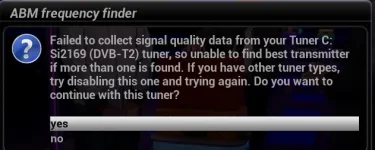
(b) If no valid measure of signal quality is found the user is given the choice of continuing (using the first version of each mux found), or abandoning the search with the following message:
Tuner Msg.webp

N.B. Ignore the actual tuner type in this message - the screenshot was generated by inhibiting the use of alternative measures.

The tuner selection is currently redone for each frequency, which raises (the rather remote) possibility of a major problem if it results in a different tuner models being selected, as the quality levels reported are not consistent between tuner models. There is a lesser problem if poor cabling or uneven distribution amps lead to different signal levels to otherwise identical tuners. I have therefore changed this to run just once at the beginning. The preference for the last tuner is perhaps non-ideal, as this will favour USB tuners which are arguably less likely to be properly supported than the normal ones, but I have not changed this.

If anyone would like to try it, as a minimum they need to copy the attached file to "/usr/lib/enigma2/python/plugins/SystemPlugins/AutoBouquetsMaker/scanner/", and reboot the GUI, but if they think they may need to revert to the old version they should rename the "frequencyfinder.pyo" file in that dierectory to something like "frequencyfinder.pyo.orig" before rebooting. The reboot will create a new "frequencyfinder.pyo" file. I would welcome reports of which tuners work and which do not.

View attachment frequencyfinder.py
 
The tuner selection is currently redone for each frequency, which raises (the rather remote) possibility of a major problem if it results in a different tuner models being selected
This assumption is false. On subsequent runs the same tuner is always selected.

First iteration here: https://github.com/oe-alliance/Auto...uetsMaker/src/scanner/frequencyfinder.py#L230
Subsequent iterations here: https://github.com/oe-alliance/Auto...aker/src/scanner/frequencyfinder.py#L244-L245
 
Last edited:
Status
Not open for further replies.

OpenViX Feeds Status

Back
Top