
I doubt very much seeing a woman in a state of semi-undress is going to damage any child. They see much more just going to the beach.


2	TERMINOLOGY, CONVENTIONS, & GENERAL BACKGROUND INFO
2.1	Introduction
This section identifies terminology and conventions with which the new user may not be familiar, or where special meanings are given to more general terminology used elsewhere.
 The use of many of the terms arise from explanatory material or justifications for recommendations which are included in the current draft, but may not appear in a more polished
version, so this section may shrink significantly.

2.2	General vs Specific Meanings
Often confusion is caused when a word or phrase is given a specific meaning beyond that in general usage. In the hope of minimising this, I have either capitalised the initial letters
 or included in quotes where a specific meaning is intended that could differ from a normal interpretation. Thus <signal locator> without quotes is anything that locates signals,
whereas <“signal locator”> or <Signal Locator> is a specific feature whose functionality may not seem to be well described by those words (e.g. because its functionality has gradually
 evolved, or only part of its functionality is being used).

2.3	Services
The likes of BBC1, ITV, Channel 4, etc are often referred to as “channels”, a hangover from analogue transmission which requires one RF channel for each. However this correspondence
 between such programmes and RF channels does not apply to Freeview or similar transmission systems (see  para 2.4 below), and therefore use of the term “Service” is preferable, and
 that “channel” is reserved for the RF channels.

2.4	Tuning
This term is commonly used with two subtly different meanings, as follows:

1)	In systems supporting multiple preset/preselectable Services such as all Freeview receivers, the act of searching for all available Services, and storing/displaying them so that the
 user knows what is available and can immediately select the one he wants. This is therefore a “system” function.

2)	The act of setting up a piece of hardware known as a “tuner” to receive a particular RF channel (tuners do not normally perform the de-multiplexing needed to extract a single Service).

As the context usually makes it clear which meaning applies, I have not tried to explicitly distinguish between them.

2.5	Mux & Transport Stream
In digital transmission of TV and radio signals, data on groups of Services are multiplexed together to form one data stream which then occupies one frequency channel. This combined signal
 is known as a “multiplex”, commonly to “mux” (plural “muxes”). There is some ambiguity in the use of the term, however, in that the data streams contain information on all transmissions
 from that source, so for the same set of Services vary slightly according to source. Generally the term refers to the set of Services carried, so receipt of the same Services from different
 sources is referred to a duplication of muxes, even though the data streams are subtly different or carry different regional programmes. The data content of a mux is known as a “Transport Stream”.

2.6	Transponder
This is a term commonly used in the satellite community, and to be pedantic describes a conceptual piece of hardware to receive one mux from the ground and re-transmit it to the users
 (I use the term “conceptual” because I suspect there will always be elements that are common to 2 or more muxes, such as aerials). However it is often used to refer to the output of such
 a device – i.e. a mux. As OpenVix has a satellite rather than terrestrial background, “transponder” is sometimes used in menus and displays where “mux” would be used by those with a
 terrestrial background, so the two can be considered synonymous.

2.7	DVB Types
DVB refers to the transmission protocols use for digital television signals in the UK and Europe. It is divided into DVB-S for satellite transmissions, DVB-T for terrestrial transmissions, and
DVB-C for cable signals.

Slightly confusingly the standard used for Standard Definition (SD) signals is known as just DVB-T, and that capable of both High Definition (HD) and SD is known as DVB-T2. Thus depending
 on context “DVB-T” may refer to both, or just the former. Tuners capable of just SD are referred to as “DVB-T”, whereas all DVB-T2-capable tuners I am aware of are capable of receiving either,
 and thus are often known simply as DVB-T2. DVB-T muxes are frequently referred to as SD, and DVB-T2 muxes as HD, even though the latter sometimes carry some SD Services. The transport
 stream in DVB-T is MPEG2, whereas in DVB-T2 it is MPEG4, even for SD Services.

2.8	Scanning
To some people scanning is a process by which Service information is found by looking in many places of which only one or a few contain that information, as opposed to starting at a known
 location and following a series of cross references to the source of the information. As the technique used is irrelevant to the user, and to match terminology used elsewhere, the OpenVix
 menu does not make this distinction and uses the term “scan” for any process of collecting Service information.

2.9	Bouquets
This term covers groups of Services that are often referred to elsewhere as “favourites”. However the bouquets provide the only way for the user to access a list of available Services in
 OpenVix, so at least one bouquet is needed. You may have multiple bouquets, each defining different groupings (e.g. Freeview SD, Freeview HD, News, Children's, ...).

By convention, all tuning facilities produce a “Last Scanned” bouquet, which includes all Services but usually in the order in which they were detected. Thus TV and radio Services are
 likely to be intermingled, and the order can change with time and location – i.e. is very user-unfriendly. However you don't have to put this “Last Scanned” bouquet into the list of what
 actually gets displayed if other bouquets have been generated.

2.10	Electronic Programme Guide (EPG)
This refers to the list of future programme names and details for each Service provided to enable viewing and recording to be planned. To some people it refers solely to the feature
 that displays that information, and to others includes the data itself – using the former definition an “update to the EPG” is a software change, whereas in the latter case it also
 encompasses programme changes and addition/deletion of data as time progresses so can occur several times per hour per Service. In most cases the context makes it clear which
 is meant, but I have used the term “EPG data” where appropriate to avoid any misunderstanding.

2.11	Menu Sequences
I show menu sequences in the form of menu item names (or button presses) separated by arrows thus:

	Main menu -> Setup -> System -> Language.

You enter the Main Menu by pressing the "Menu" key on the Remote Control Unit (hereafter "RCU") while watching TV and proceed through the menu system by with the
 Up/Down keys and pressing "OK". Changes in selections are generally made with the Left & Right keys on the RCU – I have noted the one exception to this in the details below.
 Normally you move back up a layer by pressing "Exit" (not "Back"), but where changes may have been made you will be prompted to use "Green" to save changes, and "Red" to
 abandon them. It is not normally possible to leave the menu system with a single keypress such as "EPG" or "TV".

2.12	Abbreviations
I have tried to use the full name etc with the abbreviation in brackets the first time each term is used, but have collected them together here in case I have missed one, or users have
 skipped the relevant section.

•	ABM: 	“AutoBouquetMaker” – a plug-in bundled with OpenVix which is one of the tuning options.

•	DTFF:  “DVB-T frequency finder” – an ABM feature that locates available muxes but not the Services therein.

•	DVB-x: Digital Video Broadcasting, the formats etc for transmission of digital TV signals by cable (-C), from satellites (-S), and from ground-based transmitters (-T).

•	EPG: 	Electronic Programme Guide, i.e. the list of programmes with their descriptions for each Service.

•	FTA:	“Free-to-Air”, i.e. not encrypted.

•	LCN:	Logical Channel Number, the number universally used for Freeview Services.

•	MHEG: Multimedia and Hypermedia Experts Group, the standard used by Freeview and Saorview  (the Eire equivalent of Freeview) for Interactive features.

•	PVR:	Personal Video Recorder, such as OpenVix running on appropriate hardware.

•	RCU:	The PVR’s Remote Control Unit.

•	SvId:	Service Identity, which is unique to each variant (where relevant) of each Service.

• TsId: Transport Stream identity, which is unique to each mux or variant thereof.There is no connection between DVB-T and SD, nor between DVB-T2 and HD. That is just an imposition of the uk administration. Also note that SD channels carried on DVB-T muxes will be marked as type 1 and the identical channel carried on a DVB-T2 mux should be marked as type 22 so the receiver knows to allocate a DVB-T2 capable tuner for that service.

Please tell me what is wrong, or better still give me a better definition, as I do not understand what aspect you do not agree with.I do not agree with your definition of tuning.
The document will be specific to OpenVix, so it only addresses what OpenVix can do. Would you be happier if I added something along the lines of "Many of the statements concerning OpenVix also apply to other Enigma2 images, but consideration of those other images is outside the scope of this document"?You choice of words implies some items are specific to OpenViX, whereas they are applicable to all Enigma2 images.
EPG does not equal list of programs.You can have list of programs without EPG.

On paper (e.g. the Radio Times) you can, but on any display box any list will be Electronic and if it's a list of programmes it's a Guide. Surely?You can have list of programs without EPG.
Thanks - I hadn't come across this - probably because the red button "All" looks very like the "All channels" bouquet.Bouquets are not the only way to select services. You can select them by the service list.
This makes a very unfriendly facility into something that I might have used a few times, but how is anyone expected to know that the number keys are used in this way? The "Help" key does provide any information.You can jump to a letter of the alphabet using the keys.
Obviously I agree, but the question is whether they are independent, or whether there are interdependencies.EPG is EPG.
Bouquets are bouquets.
Service list is service list.
As a result of you previous comment, and my acceptance thereof, I was proposing to amend the second sentence of the bouquet definition to readThe EPG system invokes the bouquets system when activated and applicable.
"However the bouquets provide the normal way for most users to access a list of available Services in OpenVix, and the only way of accessing
 the EPG, so at least one bouquet will be needed by most users. "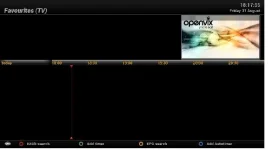
Please do me the honour of reading what is there, not what you think is there. THE DEFINITION I USED FOR EPG DOES NOT MENTION BOUQUETS OR SERVICE LISTS!A guide which confused people by using EPG as a singular definition for two/three separate systems is not helpful.
Agreed, but peoples experience, and hence their understanding of terms, may well colour their interpretation of terms such as "EPG", and therefore I want to be sure my words in later sections are not misunderstood.These are Enigma2 receivers. Not Freeview or Sky receivers.
Please do me the honour of reading what is there, not what you think is there. THE DEFINITION I USED FOR EPG DOES NOT MENTION BOUQUETS OR SERVICE LISTS!
• EPG: Electronic Programme Guide, i.e. the list of programmes with their descriptions for each Service.
2.10 Electronic Programme Guide (EPG)
This refers to the list of future programme names and details for each Service provided to enable viewing and recording to be planned. To some people it refers solely to the feature
that displays that information, and to others includes the data itself – using the former definition an “update to the EPG” is a software change, whereas in the latter case it also
encompasses programme changes and addition/deletion of data as time progresses so can occur several times per hour per Service. In most cases the context makes it clear which
is meant, but I have used the term “EPG data” where appropriate to avoid any misunderstanding.
I can only write a User Guide round what OpenVix actually does, not what it ought to do, particularly as the latter can be so subjective. However if there is a definite intention to fix a problem or improve something within a couple of weeks and the new version identity is known, then I would consider putting in statements that explain the difference in behaviour between versions.There is actually a bug in OpenViX. If there are no bouquets, it should open All Services.
3	THE FREEVIEW SYSTEM
3.1	Introduction

This section describes the key features of the Freeview system and its terminology from the perspective of OpenVix tuning.

3.2	Regions & Transmitter Groups

The term “region” has a specific meaning in the context of Freeview – it is the area served by one of the regional variants
 of BBC 1 & ITV. Unfortunately the two organisations sometime have different regional boundaries (typically one organisation
 dividing the other’s region into 2), so transmitters are divided into “Transmitter Groups”, in which each transmitter transmits a
 particular combination of regional variants.

In many areas it is possible to receive signals from transmitters for two or more groups, with the aerial orientation and type
 determining which give the best signal at the PVR. The term “your region” or similar therefore would be more pedantically
 expressed as something like “the Region associated with the best signals received by your PVR”.

There are ~15 Freeview (UK) Regions with varying in size from high hundreds of square Km to tens of thousands of Square Km
 to reflect different population densities. The Regions and Transmitter Groups associated with each transmitter can be found from
 the spreadsheets referenced here.

3.3	Service Numbering

Freeview Services have a “Logical Channel Number” (LCN) that is universally used in televisions and programme listings in
newspapers etc. There are substantial gaps in the numbering, allowing Services of similar types to have adjacent numbers,
 and thus allowing automatic removal of some Service types (e.g. Adult) or automatic generation of bouquets for particular
Service types (e.g. Children’s) based purely on LCN. The gaps allow new Services to be added without invalidating such logic.
Further gaps appear when the receiver is incapable of processing certain Service types (e.g. internet-based & text Services in
the case of OpenVix). A list of Services can be found at https://www.radioandtelly.co.uk/freeviewchannels.html.

The LCNs are only employed in the user-interface, and the actual selection of Services is by a parameter known as
 “Service Id” (SvId), which is unique across the network, so regional variants of Services have the same LCN but different SvIds.

N.B. LCNs in the range 690-699 are used for test & other temporary Services.

3.4	EPG Data

Each mux carries all the EPG data for all the Services in its Transmitter Group, but not for Services in other Transmitter Groups.
 This allows single tuner devices such as televisions to display the EPG data on Services on muxes other than that currently in use.
 Thus if not all muxes are received, the full set of schedule information for the Region is still available, which is somewhat confusing
 to the user if the irrelevant information is not suppressed in some way. Data for individual Services is identified by SvId, avoiding
 the regional ambiguities in the use of LCNs.

As it is impractical to transmit all the EPG data in one data frame, the EPG data is transmitted as individual events, with an Event
 Number to allow correlation between subsequent transmissions of the same data. I suspect different Transmitter Groups use
 different Event Numbers for the same programme.

3.5	Mux Names & Ids.

The principal Freeview muxes are designated PSB1, PSB2, PSB3, COM4, COM5, COM6, COM7, & COM8, and are supplemented in
 populous areas by local muxes. The contents of the muxes can be found at sites such https://ukfree.tv/transmitters/multiplexes,
 though as with so much information on the internet it is difficult to find reliable and guaranteed up-to-date sources. The principal
 mux names are not affected by regional variations in BBC 1 & ITV, so the mux names need to be qualified if you wish to refer to
 just one regional variant (e.g. “PSB1” refers to a mux including any regional variant of BBC 1, and PSB1 (Anglia) refers to the
 variant transmitted in the Anglia region).

The muxes are allocated Transport Stream Identities (TsId’s) which reflect any variation in Service content, but not variations in
 ancillary information such as EPG data and transmitter details. Thus PSB1 & PSB2’s TsIds vary by region, (as of August 2018)
 PSB3 has one TsId for London and another for elsewhere, and COM5-8 have the same TsIds nationwide.

3.6	Mux Types

Freeview uses originally used just the DVB-T standard and only included Standard Definition (SD) video, and then introduced
 the DVB-T2 standards on an additional mux (PSB3) to carry High Definition (HD) video without a major reduction in the number
 of Services that could be carried. As a result the muxes are often referred to as SD and HD respectively, even though the DVB-T2
 muxes include some SD Services and DVB-T could carry HD video. When the COM7, COM8, & local muxes were added the more
 efficient DVB-T2 standard was adopted. I believe there has been talk of upgrading all the muxes to DVB-T2 to allow additional
 Services or reduce the number of muxes (and hence spectrum utilisation) required, but such a move would make many televisions
 useless so is likely to be some time away.

3.7	Freeview Transmitters

Freeview has three “levels” of transmitter, as follows:

•	Freeview Extra, which transmit muxes PSB1, PSB2, PSB3, COM4, COM5, COM6 at high power plus some combination
 of COM7, COM8 and local muxes generally at a lower power. Different local muxes may be transmitted on the same frequency
 using directional aerials to limit interference – the term “petal” is used to describe these transmissions.

•	Full Freeview which transmit PSB1, PSB2, PSB3, COM4, COM5, COM6 only.

•	Freeview Light, which transmit PSB1, PSB2, and PSB3 only.

The Freeview Light transmitters are divided into groups together with one Full or Extra Transmitter, and transmit precisely the
 same data streams as the “parent”. Among other things, this means that the programme guide etc information for Services on
 the missing muxes is still available. These transmitters generally perform a “fill-in” role, transmitting at low power to cover a
 gap in the parent transmitter coverage such as a town in a steep-sided valley. Some users on the edge of the cover may also
 be able to receive COM4/5/6 from the parent “Full” transmitter while receiving a better signal for PSB1/2/3 from the
Light transmitter.

3.8	Mixing Signals From Different Transmitter Groups

In some areas it is possible to receive signals from more than one Transmitter Group. While receiving different muxes from different
 groups will not affect the audio and video, there will be problems with the EPG (at least). Take the case where the PSB muxes are
 obtained from Transmitter Group 1, and the COM muxes from Transmitter Group 2, then:

•	If the EPG data is obtained from a PSB mux, all will be OK, as the COM muxes contain the same services with the same SvIds
 as they would if they were received from group 1.

•	If the EPG data is obtained from a COM mux, then it will refer to the regionalised Services using the SvIds appropriate to Transmitter
 Group 2, but these will not exist in the Service list or any bouquet, and so the BBC1, ITV and possibly BBC1 HD, EPG data will be missing,
 and the EPG display will be omit these services completely.

As the mux being used to collect EPG data is not under user control and affected by recordings starting, for the non-expert the regionalised
 Service EPG would appear to come and go in a random fashion.

If the numbering of common elements of the EPG data is not identical between Transmitter Groups (as would seem likely), it would probably
 be necessary to clear all the EPG data when changing the source mux.

3.9	Transmitter Frequencies

You can find the current frequencies, planned changes and muxes of transmitters serving your location by entering your postcode at
http://www.digitaluk.co.uk/coveragechecker. Which of those transmitters is optimum for you will depend on factors such as aerial
 orientation (which may not be obvious with a communal aerial system) or very localised obstructions (e.g. a bungalow with adjacent
 tall buildings). You may wish to use a non-optimum transmitter tin order to receive its regional programmes, but this will normally
 require re-orientation of your aerial and perhaps use of a different aerial optimised for the new frequencies.

3.10	Interactive Services

The “Interactive” Services in the UK and Eire are provided using “MHEG”, which is described in some detail here. It is used in
 several ways:

1)	To implement the BBC’s “Red Button” facility on BBC TV Services.
2)	To provide information on current programme beyond that in the EPG on Radio Services.
3)	To provide some text + crude graphic Services which have no audio or video.
4)	To allow broadcast of information such as need to retune.
5)	Implement the Freeview “IPTV” Services which look to the user like normal Services having EPG etc entries, but use
 the internet rather than the transmitted signals as the source of video and audio.

Of these, implementation of 1-4 appear to be universal on UK market televisions sets, but 5 seems to be unusual in my limited
 experience. However none are implemented by OpenVix.

Though the BBC “Red button” Services are intended to be accessed by the Interactive facilities, they are in fact normal TV Services
 which can be accessed by any TV or PVR (including OpenVix) via the LCN etc.

3.11	Changes

There are two types of change that affect use of every Freeview receiver as follows:

1)	Very infrequent changes of transmitted frequency or the addition of new muxes, which in the past have probably averaged
 once per ~3 years for most transmitters, possibly nearer one per year for the Extended Freeview transmitters. As of August 2018
 we are ~half way through a period of revised frequency allocations to free up some of the frequency band for mobile telephone
 use (see here for more information) – those that have not had their frequencies changed recently can expect them to change in
 the next 2 years.

2)	Changes to the mux contents, which have occurred at irregular intervals, perhaps averaging ~2 months. These changes
have included Service name changes, LCN changes, movement of Services between muxes, and the addition & removal of Services.

LCN changes and new Services potentially invalidate automatic processes to generate bouquets, or hide, categories of Services
 where these are based on the LCN numbering system.

When Services are moved between muxes, they normally continue to be transmitted on the old mux with an LCN in the 690’s for
 a few weeks. Until a rescan is performed the change of LCN will not be recognised so all will appear normal till the old version is
 discontinued. A warning to rescan is normally transmitted via the Interactive facilities, but will not be visible on OpenVix PVRs
 (see para 3.10 above).
